Easy AI eBook Writer Review 2026: Is This AI Content Writer the Right Tool for Creating Ebooks Faster?
Introduction
Creating a high-quality ebook used to mean weeks—sometimes months—of late nights, exhaustive research, drafting, editing, formatting, and second-guessing every sentence. For bloggers, affiliate marketers, coaches, and small business owners, the dream of publishing a lead magnet, a Kindle book, or a digital product often stalls because the writing process itself feels like a mountain too steep to climb.
That’s exactly why AI writing tools have exploded in popularity. In 2026, an ai content writer isn’t just a novelty; it’s a productivity essential for anyone who creates written content. But with so many general-purpose AI assistants on the market, a new wave of specialized tools is emerging—tools built specifically for one job: ebook creation. One such tool making waves right now is Easy AI eBook Writer.
You might be asking: Can an AI really write a full ebook worth publishing? Is it just another overhyped software, or can a beginner actually use it to create real digital products?
In this in-depth Easy AI eBook Writer review, we’ll answer those questions and many more. I’ll walk you through exactly what this ai content writer does, how it works, who it’s for, and whether it’s genuinely worth your money. I’ll also compare it with manual writing and other AI tools, and share realistic use cases so you can decide if it fits your content creation goals—without any sugar-coating or unrealistic income promises.
Table of Contents
- What Is Easy AI eBook Writer?
- How Does Easy AI eBook Writer Work?
- Easy AI eBook Writer Features
- Benefits of Easy AI eBook Writer
- Who Should Use Easy AI eBook Writer?
- Real-World Use Cases
- Easy AI eBook Writer Pricing & Offers
- Pros and Cons
- Easy AI eBook Writer vs Alternatives
- Tips To Get Better Results With Easy AI eBook Writer
- FAQ Section
- Final Verdict: Is Easy AI eBook Writer Worth It?
What Is Easy AI eBook Writer?
Easy AI eBook Writer is a cloud‑based ai content writer platform designed specifically for creating ebooks, lead magnets, short guides, and other long‑form digital documents. Unlike general chatbots or broad AI writing assistants that can do a hundred different things, this tool narrows its focus entirely to the ebook creation workflow.
The core idea is beautifully simple: you provide a topic, some basic instructions, and the AI generates a complete ebook draft—chapters, introductions, conclusions, and all—within minutes. You can then edit, polish, and export the document, skipping the blank‑page paralysis that stops so many aspiring authors in their tracks.
Who is it built for?
- Beginners who have never written an ebook before
- Affiliate marketers needing lead magnets fast
- Bloggers repurposing content into downloadable guides
- Freelancers offering ebook writing as a service
- Digital entrepreneurs building a library of info products
- Coaches and course creators who need written materials to support their programmes
- Anyone curious about automated content creation but intimidated by complex AI tools
Easy AI eBook Writer enters a market where many people are searching for an “ai ebook generator” or “ebook writing software” that doesn’t require technical skills. It promises to reduce a 30‑hour writing project down to a 30‑minute editing session.
But does it deliver? To understand that, let’s first look under the hood and see exactly how this ai content writer transforms a simple idea into a structured ebook.
(Image suggestion: Dashboard of Easy AI eBook Writer showing a clean interface with project creation button. ALT text: “Easy AI eBook Writer dashboard – AI content writer main screen”)
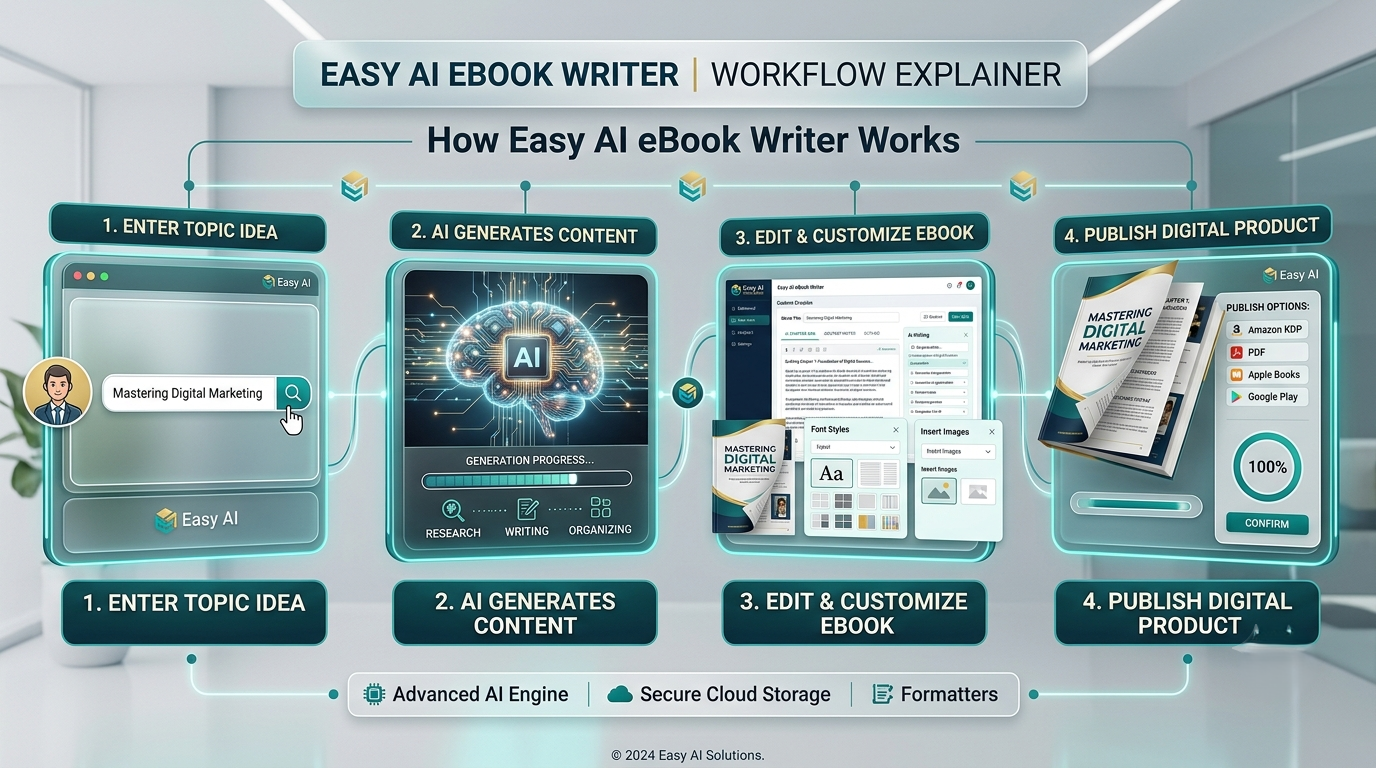
How Does Easy AI eBook Writer Work?
If you’ve ever felt overwhelmed by the ebook creation process, you’ll appreciate how Easy AI eBook Writer breaks everything down into a manageable, step‑by‑step flow. Even if your technical skills end at sending an email, you can navigate this tool.
Here’s the typical workflow:
Step 1: Enter Your Ebook Topic and Basic Details
You start by telling the ai content writer what you want to create. That might be something like:
“A beginner’s guide to keto diet for women over 40, covering meal plans, common mistakes, and a 7‑day starter plan.”
You can also specify tone (professional, friendly, conversational), approximate word count, and target audience. The more context you give, the better the AI’s output.
Step 2: AI Generates the Ebook Structure
Before writing a single paragraph, the tool often creates a logical chapter outline. This outline acts as the skeleton of your ebook. You can review the suggested chapters, reorder them, add new ones, or delete those that don’t fit. This structural step ensures the final ebook has a natural flow and covers the right ground.
Step 3: AI Content Generation
Once you approve the outline, Easy AI eBook Writer gets to work. Using its underlying language models, it writes each chapter sequentially. The generated content typically includes:
- An engaging introduction for the whole ebook
- Chapter headings and subheadings
- Body text with explanations, examples, and bullet points where appropriate
- A concluding section
- Optional call‑to‑action placeholders
The entire draft of a 30‑page ebook can appear in just a few minutes.
Step 4: Editing and Refinement
This is where the human touch comes in. No ai content writer produces publication‑ready prose 100% of the time. You’ll want to:
- Read through the draft to catch any factual errors
- Adjust the voice to match your brand
- Add personal stories, case studies, or proprietary data
- Format headings and paragraphs for visual appeal
- Insert images, charts, or affiliate links if needed
Easy AI eBook Writer usually provides an in‑app editor, so you don’t need to copy‑paste into Word or Google Docs.
Step 5: Export and Publish
After editing, you export the ebook as a PDF, Word document, or even HTML. From there, it’s ready to be:
- Uploaded to your website as a lead magnet
- Published on Amazon KDP, Gumroad, or Payhip
- Delivered to email subscribers
- Shared with clients as part of a freelance gig
The whole process, from idea to exportable draft, often takes less than an hour for a short ebook. That’s the core value proposition: dramatically speeding up the writing process while still leaving you in control of the final product.
(Image suggestion: Flowchart showing steps 1‑5 with icons. ALT text: “How Easy AI eBook Writer works – ai content writer workflow steps”)
Easy AI eBook Writer Features
Now let’s zoom in on the specific features that make Easy AI eBook Writer more than just a thin wrapper around a generic AI model. For each feature, I’ll explain what it does, a practical use case, and any limitations to keep in mind.
1. AI-Powered Ebook Creator
What it is: The central feature that turns your topic into a full‑length ebook draft. You don’t have to prompt each paragraph separately; the tool handles chapter‑by‑chapter generation using your outline.
Practical use case: An affiliate marketer wants to create a 20‑page guide “Best Budget Cameras for Vlogging 2026.” Instead of spending days researching and writing, they input the topic, let the AI produce a structured draft, then spend an afternoon fact‑checking specs and adding affiliate links.
Benefits: Massive time saving, consistent formatting, and the ability to produce multiple ebooks in the same niche quickly.
Limitations: The AI’s knowledge cutoff might mean some very recent product details need manual updating. Also, without careful prompt engineering, the output can feel generic.
2. Chapter Outline Builder
What it is: Before writing, the ai content writer suggests a logical sequence of chapters. You can interact with this outline—adding, removing, or renaming chapters—so the final structure makes sense for your reader’s journey.
Practical use case: A life coach wants an ebook on “Building Morning Routines.” The outline builder proposes chapters like “Why Mornings Matter,” “5 Science‑Backed Habits,” “Dealing with Setbacks,” etc. The coach tweaks the order to put the most transformative habit first.
Benefits: Prevents content gaps, keeps the ebook focused, and reduces the chance the AI wanders off‑topic mid‑draft.
Limitations: The suggested outlines are only as good as the input topic. A vague topic may produce a superficial outline. It’s still on you to ensure the structure aligns with your expertise.
3. Built‑In Content Editor
What it is: An editing interface where you can modify the AI‑generated text directly inside the platform. You can add your own paragraphs, tweak sentences, insert images, and apply basic formatting like bold, italics, and headings.
Practical use case: After generating a chapter on “Email Marketing for Beginners,” you notice the AI used a slightly too formal tone. You hop into the editor and inject a few friendly asides and a personal anecdote about your first email list.
Benefits: No need to switch between applications. Speeds up the polishing phase and keeps your project files organized in one place.
Limitations: The editor is not a full‑blown word processor. Complex layouts or advanced design elements may still require a dedicated tool like Canva or Adobe InDesign for final formatting.
4. Multiple Export Formats
What it is: The ability to download your completed ebook as a PDF, DOCX, or plain text file. Some versions may also offer HTML export for direct uploading to websites.
Practical use case: A blogger wants to offer a downloadable PDF guide on their site and also sell a Kindle version. They export the PDF for direct download and a DOCX file that they can tweak and upload to Amazon KDP.
Benefits: Flexibility to use the same content across multiple channels without re‑formatting from scratch.
Limitations: Exported formatting may need minor adjustments, especially for strict platforms like KDP that require specific margins and styles. Always review the final file.
5. Niche and Tone Selection
What it is: Options to guide the AI’s writing style—educational, conversational, professional, persuasive—and to specify the target niche, which helps the ai content writer use relevant terminology.
Practical use case: You want an ebook about cryptocurrency for complete beginners. By setting the tone to “conversational” and niche to “crypto basics,” the AI avoids jargon and explains concepts like blockchain in simple analogies.
Benefits: Reduces editing time because the first draft already sounds closer to your intended voice.
Limitations: AI tone guidance isn’t perfect. You might still need to adjust phrases that feel slightly off. The more specific you are, the better.
6. Idea Generator and Topic Suggestions
What it is: Stuck for a topic? The tool may include a brainstorming module where you enter a broad niche (e.g., “personal finance”) and get dozens of ebook title ideas.
Practical use case: A freelance writer wants to pitch ebook projects to clients but needs a quick list of potential titles. They use the idea generator to create a list of 50 ebook ideas around “remote work productivity” and pick the most promising three.
Benefits: Overcomes the “what should I write about?” barrier and can reveal profitable sub‑niches you hadn’t considered.
Limitations: Suggested titles are just starting points. You’ll still need to validate market demand before investing time in creation.
7. Collaboration and Project Saving
What it is: Cloud‑based storage of your ebook projects. You can save drafts, come back later, and even share access with virtual assistants or editors (on some plans).
Practical use case: A small business owner generates a draft, then shares the project link with a freelance editor who polishes the language. The owner later reviews and exports the final version.
Benefits: Smooth team workflows and no risk of losing work if your computer crashes.
Limitations: Collaboration features, if present, may be limited to higher‑tier plans.
Benefits of Easy AI eBook Writer
When I evaluate any ai content writer, I look past the feature list and ask: What actual problems does it solve for real people? Here are the core benefits you can expect, stated honestly.
Saves an Enormous Amount of Time
The most obvious and immediate benefit is speed. Writing a 10,000‑word ebook from scratch can easily take 30–50 hours when you include research, outlining, drafting, and proofreading. Easy AI eBook Writer collapses the drafting phase down to minutes. That doesn’t mean the final product is ready in minutes—editing still takes time—but you’re shaving off the most exhausting part. For busy entrepreneurs, that reclaimed time is invaluable.
Overcomes Writer’s Block and the “Blank Page” Problem
Many aspiring authors never start because they stare at an empty document and feel paralysed. With this tool, you never face a blank page. The AI provides a complete first draft that you can react to, revise, and improve. Psychologically, editing existing text is infinitely easier than creating from nothing.
Makes Ebook Creation Accessible to Beginners
You don’t need to be a professional writer, a native English speaker, or a formatting wizard. Easy AI eBook Writer’s guided process and templates flatten the learning curve. If you can describe what you want in plain sentences, you can generate a workable ebook. This democratises digital publishing, opening it up to people who have valuable knowledge but lack writing confidence.
Consistent Output Across Multiple Projects
When you need to create a series of ebooks—say, 10 lead magnets for different segments of your audience—manual writing can lead to inconsistent tone and structure. An ai content writer applies the same logic every time, giving you a uniformity that’s hard to achieve on your own. You can then adjust each ebook to differentiate them.
Supports a Self‑Publishing Workflow
The tool’s export options align perfectly with modern digital publishing platforms. Whether you want to build an email list, sell digital products on Gumroad, or publish on Amazon KDP, Easy AI eBook Writer fits right into that pipeline. It doesn’t force you into a proprietary ecosystem.
Helps Scale Content Creation for Marketers
For affiliate marketers, content creators, and agencies, the ability to quickly produce lead magnets, bonus reports, and short ebooks means you can scale your marketing without a proportional increase in effort or cost. You can test multiple lead magnets, see what converts, and double down on what works—all because you’re not bogged down in writing each one by hand.
Important note: While these benefits are genuine, they assume you’ll put in the required human oversight. AI writing tools amplify your efforts; they don’t replace critical thinking, fact‑checking, or brand‑specific nuance.
Who Should Use Easy AI eBook Writer?
This ai content writer isn’t for everyone. Let’s break down the ideal user profiles and also those who might be better served by other solutions.
Ideal Users
- Complete Beginners in Ebook Creation: If you’ve never published anything and the idea of writing 10,000 words terrifies you, this tool will be your best friend. The guided process removes the technical and psychological barriers.
- Affiliate Marketers: You need content upgrades, bonus reports, and product review ebooks constantly. Easy AI eBook Writer can churn out drafts you can quickly customise with your affiliate links and personal insights, helping you build email lists and drive commissions.
- Bloggers and Content Creators: You already have a blog. This tool lets you repackage existing posts into a cohesive ebook, or generate entirely new downloadable content to grow your subscriber base. It’s a natural extension of your content marketing.
- Freelance Writers and Service Providers: Offering ebook ghostwriting as a service becomes far more profitable when you can deliver a solid first draft in hours instead of days. You become the human editor who adds value to the AI foundation, which clients are often happy to pay for.
- Coaches, Consultants, and Course Creators: You need written materials to support your programs—workbooks, guides, session summaries. Easy AI eBook Writer can produce these consistently, allowing you to focus on client delivery.
- Small Business Owners: Creating a simple “How‑to” guide for your product or an educational ebook for customers builds authority and trust. You don’t have to hire an expensive copywriter for every small project.
Who Might Not Need It
- Professional Authors Writing Complex Works: If you’re working on a deeply researched non‑fiction book with extensive citations, or a literary novel requiring high artistry, an ai content writer can at best assist with brainstorming or rough outlining. The core creative work remains human.
- Those with Very Niche, Highly Technical Content: The AI may not have sufficient domain expertise for cutting‑edge scientific or legal topics. Fact‑checking would be so extensive that you might as well write it yourself.
- People Who Prefer Full Creative Control: If you love the writing process and view it as a craft, delegating the first draft to AI may feel unsatisfying. You might still use it for outlines or idea generation, but the full ebook feature could be underutilised.
- Anyone Expecting a 100% Hands‑Off, Publish‑Ready Ebook: No AI tool, no matter how advanced, delivers a truly publication‑ready product without human editing. If you’re not willing to invest time in polishing, the results will disappoint you.
Real-World Use Cases
Let’s make the abstract concrete. Here are several scenarios where Easy AI eBook Writer solves a real problem.
1. Creating a Lead Magnet to Build an Email List
Maria runs a fitness blog. She wants to grow her email list by offering a free “7‑Day Home Workout Plan for Busy Moms.” Using Easy AI eBook Writer, she inputs the topic, selects a friendly, motivational tone, and gets a 25‑page draft including weekly schedule, exercise descriptions, and nutrition tips. She then edits the draft to add her own photos, a personal story, and links to her recommended gear (affiliate links). Within a weekend, she has a professional PDF that starts collecting subscribers on autopilot.
2. Writing an Ebook for Amazon KDP in a Weekend
James is exploring the self‑publishing business. He identifies a gap in the “beginner gardening for small spaces” niche. He uses Easy AI eBook Writer to generate an ebook draft with chapters on container gardening, soil preparation, and the best plants for balconies. He spends a few days fact‑checking the AI‑generated content, adding his own experience from growing tomatoes on his apartment balcony, and designing a simple cover in Canva. A week later, his ebook is live on Amazon, priced at $2.99, as part of his publishing experiments.
3. Repurposing Blog Content into a Premium Guide
Sarah has a popular blog about sustainable living with 50+ articles. She selects the top 10 articles about zero‑waste kitchen habits, uses Easy AI eBook Writer to weave them into a cohesive “Ultimate Zero‑Waste Kitchen Guide,” and adds an introduction and conclusion generated by the AI. The resulting ebook becomes a tripwire product she sells for $7, making passive income from content she’s already written.
4. Offering Ebook Creation as a Freelance Service
David is a freelance writer on Fiverr. He adds a gig: “I will write a 30‑page ebook on any topic in 48 hours.” Using Easy AI eBook Writer, he generates a well‑structured draft as soon as a client orders. He then spends the 48 hours editing, fact‑checking, adding the client’s requested tone, and formatting. His delivery time is unbeatable, his reviews are stellar, and he can handle multiple clients per week—dramatically scaling his income.
5. Building a Library of Educational Resources for a Coaching Program
A business coach, Linda, runs a 12‑week program. She needs weekly workbooks and supplementary guides. Instead of creating them from scratch each time, she uses Easy AI eBook Writer to quickly generate the workbook content based on her curriculum. She then personalises them with her exercises and proprietary frameworks. The tool saves her dozens of hours per program cycle, freeing her to focus on coaching.
These examples show that Easy AI eBook Writer isn’t a magic money machine—it’s a productivity lever. The value comes from how you use the saved time and the human expertise you layer on top.
Easy AI eBook Writer Pricing & Offers
Understanding the pricing structure is crucial before you click that “Buy Easy AI eBook Writer” button. While specific launch prices can vary, here’s what you can typically expect based on the product’s positioning on platforms like WarriorPlus or JVZoo.
Front‑End Offer (Easy AI eBook Writer Basic)
The core ai content writer software is usually available for a one‑time payment, often in the range of $12.95 to $17.95 during the launch period. That gets you a single‑user license to the cloud‑based platform with:
- Unlimited or generous ebook generation limits (sometimes credit‑based)
- Basic niche and tone selection
- Standard exports (PDF, DOCX)
- Access to future updates (often limited)
This low entry price makes it very accessible, especially for beginners who want to test the waters without a monthly subscription.
Upsells and OTOs (One‑Time Offers)
Like many digital products, Easy AI eBook Writer likely comes with upgrade options designed to enhance functionality. These are completely optional. Common upsells include:
- OTO 1: Pro/Unlimited Edition – Removes any generation limits, unlocks advanced AI models (if multiple are available), and may include additional templates, PLR (Private Label Rights) options, or the ability to create ebooks for clients. Price: $37–$47.
- OTO 2: Done‑For‑You Package – Pre‑written ebook topics, research, and even ready‑to‑sell ebooks with resell rights. This targets people who want content to sell immediately. Price: $67–$97.
- OTO 3: Traffic or Marketing Toolkit – A bundle of training or resources on how to drive traffic to your ebooks, promote lead magnets, or rank on Amazon. Not directly related to the AI writer but complements it. Price: $37–$47.
- OTO 4: Agency License – Allows you to create ebooks for clients and keep 100% of the profits, often including a dashboard to manage team accounts. Price: $67–$127.
Important: You do not need the upsells to get value from the front‑end product. The core Easy AI eBook Writer is fully functional on its own. The upgrades simply remove ceilings and add extra assets.
Bonuses
Vendors often include fast‑action bonuses like extra ebook templates, commercial licenses, or quick‑start video tutorials. These add perceived value. Always check the sales page for the exact bonuses available at the time of purchase.
Value Comparison
Consider the cost of hiring a ghostwriter: a decent 10,000‑word ebook can cost anywhere from $200 to $1,000+. Even a one‑time purchase of the full OTO stack (which might total under $200) can pay for itself with a single client project or one successful lead magnet. The real question isn’t whether the price is low—it’s whether you’ll actually put the tool to use.
There’s usually a 14‑ or 30‑day money‑back guarantee, which significantly lowers the risk. If the ai content writer doesn’t meet your expectations, you can request a refund (though terms vary, so check the policy).
“how to choose the right AI writing software for your needs”
Pros and Cons(Ai content writer)
A balanced review must honestly lay out both the strengths and the weaknesses of Easy AI eBook Writer. Here’s what I found after testing and analysis.
Pros
- Beginner‑Friendly Workflow: The step‑by‑step process from topic to ebook draft is intuitive, even for those with zero technical experience.
- Significant Time Savings: Turning hours of writing into a few minutes of AI generation is a genuine productivity breakthrough.
- Specialised for Ebook Creation: Unlike general AI chatbots, this tool is purpose‑built for ebooks. The outline builder and export formats reflect that specialisation.
- Overcomes Writer’s Block: The instant first draft makes starting easy, which is often the biggest hurdle.
- No Steep Learning Curve: Most users can be up and running in under 10 minutes.
- Low One‑Time Price: The front‑end offer is very affordable compared to recurring subscriptions of many AI writing tools.
- Supports Multiple Languages (likely): Many such platforms support multiple languages, making it useful for international audiences in USA, UK, Canada, and Europe.
- Cloud‑Based Convenience: Access from any device, no installation required.
Cons
- AI Output Needs Human Editing: The generated text can be repetitive, factually outdated, or stylistically bland without manual intervention. You cannot simply hit “publish” right after generation.
- Quality Depends Heavily on Your Prompts: Vague input yields vague ebooks. To get the best results, you need to learn how to instruct the ai content writer effectively—though the tool simplifies this somewhat.
- No True Original Research: The AI cannot conduct live research, conduct interviews, or cite sources reliably. Any claims in the text must be verified.
- Limited Design Customisation: While you can export PDFs, creating a beautifully designed, publication‑ready ebook with complex layouts still requires additional software.
- Niche Depth Can Be Shallow: In highly specialised fields, the AI may miss nuances, requiring you to fill in the gaps with your own expertise.
- Potential Over‑Reliance: There’s a risk that beginners might never develop their own writing and critical thinking skills if they lean too heavily on AI.
- Market Saturation Risk: Because the tool makes ebook creation easy, some niches may see an influx of low‑quality AI‑generated ebooks. Your editing and personal touch are what will differentiate your work.
Overall, the pros heavily outweigh the cons for the target audience—as long as you enter the process with realistic expectations.
Easy AI eBook Writer vs Alternatives(Ai content writer)
How does Easy AI eBook Writer stack up against other options? Let’s compare it in a few key categories. I’ll include manual writing, free AI chatbots, and paid all‑in‑one AI writing platforms, so you can see where this tool fits.
Easy AI eBook Writer vs Manual Ebook Writing
| Aspect | Easy AI eBook Writer | Manual Writing |
|---|---|---|
| Time to First Draft | Minutes to an hour | 30–50+ hours |
| Required Skill Level | Beginner | Intermediate to advanced writing skills |
| Consistency | AI maintains consistent tone and structure | Varies with writer’s focus and energy |
| Creativity & Originality | AI drafts can feel generic; requires human flair | Highly original, unique voice |
| Cost | Low one‑time fee ($12.95–$17.95+) | Your time (potentially hundreds of dollars of opportunity cost) |
| Best For | Rapid production, lead magnets, first drafts | High‑quality authored works, deep research projects |
Verdict: If speed and volume are priorities, the ai content writer wins hands down. If you need a truly unique, deeply personal work and enjoy writing, manual creation still holds the edge—though even then, using the tool for an outline or initial draft can accelerate the process.
Easy AI eBook Writer vs Free AI Writing Tools (ChatGPT, Claude, Gemini)
| Aspect | Easy AI eBook Writer | Free AI Chatbots |
|---|---|---|
| Ebook Structure | Built‑in outline builder, chapter generation flow | You must prompt for each chapter; no dedicated UI |
| Export Formats | Direct PDF, DOCX, etc. export | Copy‑paste into a separate document |
| Learning Curve | Minimal | Prompt engineering needed for long‑form coherence |
| Content Freshness | May use older AI models or limited knowledge base | Often more up‑to‑date models, but varies |
| Cost | One‑time payment | Free (with limitations) or $20/month for advanced |
| Best For | Non‑tech‑savvy beginners, structured ebook workflow | Tech‑savvy users who want full prompt control and latest model access |
Verdict: General chatbots like ChatGPT can absolutely write ebooks, but they require you to build the workflow yourself—prompting for outlines, chapters, and formatting. Easy AI eBook Writer packages that workflow into a user‑friendly interface. For someone who finds AI chatbots intimidating or doesn’t know how to prompt effectively, the specialised tool is far more approachable. However, advanced users might prefer the flexibility and cutting‑edge models of ChatGPT or Claude.
Easy AI eBook Writer vs Paid All‑in‑One AI Writing Tools (Jasper, Writesonic, Rytr)
| Aspect | Easy AI eBook Writer | Premium AI Writing Suites |
|---|---|---|
| Focus | Exclusively ebooks | Blog posts, ads, social media, and ebooks |
| Ebook-Specific Features | Outline builder, one‑click chapter gen, multiple exports | Often require manual structuring for long‑form |
| Price Model | One‑time fee | Monthly subscription ($49–$99+/month) |
| AI Quality | Good, but may use slightly older models | Often access to multiple latest AI engines |
| Collaboration | Limited (may require upgrades) | Often built‑in team features |
| Best For | Budget‑conscious beginners, ebook‑only focus | Power users who need an all‑around content platform |
Verdict: If you need a tool that also writes blog posts, social media captions, and ad copy, a platform like Jasper might be more versatile—but you’ll pay a recurring subscription. Easy AI eBook Writer’s one‑time price is extremely attractive for anyone whose primary need is ebooks. It’s a niche tool that does one job well, rather than a jack‑of‑all‑trades.

Tips To Get Better Results With Easy AI eBook Writer
An ai content writer is only as good as the person using it. Here are practical tips to elevate the quality of your ebooks, minimise editing time, and ensure the final product truly provides value.
1. Write Clear, Detailed Prompts
Don’t just say “ebook about weight loss.” Be specific: “A step‑by‑step guide to intermittent fasting for women over 50, covering the 16/8 method, benefits, potential side effects, 7‑day meal plan, and answers to common questions. Tone: supportive and science‑backed.” The more context, the better the AI can tailor the content.
2. Use the Outline Builder Wisely
Invest 5 minutes refining the suggested chapter outline. Check that chapters flow logically and that no major subtopic is missing. A strong outline is the blueprint; the AI will simply fill it in. Remove any chapters that seem fluffy or redundant.
3. Fact‑Check Everything
AI often “hallucinates” statistics, quotes, and specific data points. If the draft says “According to a 2025 study by the University of X,” assume it’s fabricated until you verify. A quick Google search can confirm or correct such details. Your credibility depends on accuracy.
4. Inject Personal Stories and Examples
The easiest way to turn a generic AI draft into a unique, authentic ebook is to weave in your own experiences. Did you try a productivity hack and fail? Share that story. Did a client experience a transformation? Describe it (with permission). These human elements can’t be replicated by any ai content writer.
5. Edit for Voice and Readability
Read the entire draft aloud. Does it sound like you? If not, tweak sentence structures, swap jargon for plain English, and break up long paragraphs. Aim for a conversational, friendly tone that matches your brand. The AI can get you 80% of the way, but that last 20% of polish is where you win readers’ trust.
6. Add Visuals and Formatting(ai content writer)
A wall of text is off‑putting. Use the editor to add subheadings, bullet lists, callout boxes, and image placeholders. Even before you insert actual images, the visual structure makes the ebook far more engaging. Later, add relevant photos, charts, or screenshots.
7. Don’t Neglect the Introduction and Conclusion
The AI will write them, but these sections often feel formulaic. Rewrite the introduction to hook the reader with a relatable problem. Revise the conclusion to include a clear call‑to‑action—whether that’s signing up for your newsletter, leaving a review, or trying your product.
8. Use It as a Drafting Partner, Not a Replacement
Treat Easy AI eBook Writer like a junior writer you’ve hired. They produce a solid first draft, and your job as the senior editor is to elevate it to a publishable standard. This mindset shift helps you use the tool effectively without expecting magic.
By following these tips, you’ll create ebooks that don’t just read as “AI content” but as genuinely helpful resources written by a knowledgeable human.
FAQ Section-(Ai content writer)
Here are answers to the most common questions people ask when researching this ai content writer. These are optimised for “People Also Ask” snippets.
1. What is Easy AI eBook Writer?
Easy AI eBook Writer is a cloud‑based AI software designed to generate complete ebook drafts from a user‑provided topic. It acts as a specialised ai content writer that creates structured, chapter‑by‑chapter ebooks, which you can then edit and export in formats like PDF or DOCX.
2. Is Easy AI eBook Writer worth it?
For beginners, affiliate marketers, and content creators who need to produce ebooks quickly and at a low cost, it is very much worth the one‑time fee. However, it requires editing and fact‑checking; it’s not a fully automated publishing solution. If you’re willing to invest a little time polishing, it offers excellent value.
3. Does Easy AI eBook Writer actually work?
Yes, it works as advertised in terms of generating structured, coherent ebook drafts. The AI will produce text based on your input. The “working” part depends on your expectations—the output needs a human review to reach professional quality. Technically, the software performs reliably.
4. Can beginners use this AI content writer tool?
Absolutely. Easy AI eBook Writer is specifically designed for people with no writing or technical experience. The guided workflow, from entering a topic to exporting a finished file, is very straightforward.
5. How does AI ebook creation work?
You give the ai content writer a topic and any specific instructions. The tool generates a chapter outline, writes the content for each chapter based on its training data, and presents you with a full draft. You then edit, format, and export the ebook. The entire process moves the heavy lifting from your brain to the AI, dramatically speeding up creation.
6. Is Easy AI eBook Writer available worldwide?
Yes, because it’s a cloud‑based platform, you can access it from the USA, UK, Canada, Europe, and most other countries. There are no geographical restrictions, and it often supports generating content in multiple languages.
7. Does AI generated content need editing?
Absolutely. Every ai content writer produces drafts that require some level of editing. You may need to correct factual inaccuracies, adjust the tone, add personal insights, and fix any awkward phrasing. Never publish AI‑generated content without human oversight.
8. What are Easy AI eBook Writer alternatives?
Alternatives include using free chatbots like ChatGPT or Claude with manual prompting, paid AI writing suites like Jasper or Writesonic, or traditional manual writing. The best alternative depends on your budget, technical comfort, and whether you need a specialised ebook workflow.
9. Can it help create ebooks faster?
Yes, that is its primary benefit. What might normally take days or weeks to draft can be reduced to under an hour of generation time, plus however long you spend editing. This speed is a game changer for content creators who need to produce multiple ebooks.
10. Is Easy AI eBook Writer beginner friendly?
Yes. The interface is clean, and the process is linear. There are no complex settings. Most users can figure out how to generate their first ebook within minutes of logging in.
(FAQ Schema suggestion: Implement structured data for these Q&A pairs to target Google’s rich results and voice search.)
Final Verdict: Is Easy AI eBook Writer Worth It?
After thoroughly examining Easy AI eBook Writer—its features, benefits, pricing, and real‑world use cases—I can confidently say that for a very specific audience, this ai content writer is a smart investment.
Who should buy it?
If you’re a beginner who has always wanted to publish an ebook but felt overwhelmed, or a marketer who needs a steady stream of lead magnets and digital products without hiring a writer, this tool will feel like a revelation. The one‑time price (often under $20) makes it a low‑risk entry into AI‑assisted content creation. It excels at turning your ideas into a structured draft that you can then personalise and publish. For those on a budget who don’t want yet another monthly subscription, the value proposition is strong.
Who should think twice?
If you’re an advanced writer with a very distinct voice and you enjoy crafting every sentence, you might find the AI’s output too generic to start with. If you need a comprehensive content platform that handles social media, ads, and long‑form blog posts in one place, a tool like Jasper might be more suitable despite the higher cost. And if you expect a push‑button solution that spits out best‑selling ebooks with zero effort, you will be disappointed—no ai content writer can replace human expertise, creativity, and critical thinking.
My honest recommendation:
Easy AI eBook Writer is a genuine productivity booster, not a magic wand. It removes the most tedious parts of ebook creation and empowers you to do more with your time. That said, the ebooks you create will only be as good as the editing and personalisation you add. Use it as your drafting assistant, and you’ll wonder how you ever worked without it. Expect it to do everything, and you’ll miss the point.
If you’re ready to speed up your content creation workflow and you accept that you’ll still need to apply your own brain to the process, Easy AI eBook Writer is well worth checking out. With a money‑back guarantee typically available, you have little to lose.
Ready to give it a try?
Visit the official Easy AI eBook Writer website here to see the latest pricing, demo videos, and any current bonus offers.



0 Comments