Best Forex Expert Advisor 2026 Review: Is Forex Market Structure and Price Action Worth Learning?
Introduction: The Real Reason Most Forex Beginners Stay Stuck
You’ve probably already typed “best forex expert advisor” into Google more times than you can count. The promise is irresistible: a piece of software that scans the charts, finds perfect trade setups, and executes them while you sleep. No learning curve, no emotional breakdowns, just passive income. But if that were true, why do most retail traders still lose money?
Here’s the uncomfortable truth: no Expert Advisor (EA) can replace a genuine understanding of how the forex market moves. Automated systems break when market conditions change because they lack the one thing that profitable human traders develop – context. That context comes from a skill called market structure analysis, combined with price action reading.
This is exactly why Oracle FX created Forex Market Structure and Price Action , a course designed to build that foundational knowledge. In this review, I’ll walk you through what the course teaches, who it’s for, and whether it deserves a spot in your trading education plan. You’ll also discover why spending time learning market structure could be far more valuable than hunting for the next “best forex expert advisor” that will inevitably blow up your demo account.
Table of Contents
- What Is Forex Market Structure and Price Action?
1.1 The Core Problem It Solves
1.2 Who Created the Course? - How Does Forex Market Structure and Price Action Work?
2.1 Understanding Market Structure Step by Step
2.2 How Price Action Complements Structure - Key Features of Forex Market Structure and Price Action
3.1 In-Depth Market Structure Training
3.2 Price Action Analysis and Candlestick Patterns
3.3 Supply and Demand Zone Identification
3.4 Liquidity Concepts and Smart Money Traps
3.5 Practical Trading Framework - Benefits of Learning Market Structure and Price Action
- Why Searching for the Best Forex Expert Advisor Might Be Holding You Back
- How This Course Compares to Using the Best Forex Expert Advisor
- Who Should Use Forex Market Structure and Price Action?
7.1 Ideal Students
7.2 Who Might Want to Skip It - Real-World Trading Use Cases
- Forex Market Structure and Price Action Pricing, Offers & Value
- Pros and Cons
- Trust & Transparency Section: Realistic Expectations
- Comparison: Market Structure Education vs. Other Learning Methods
- Best Practices to Get Better Results from the Course
- Frequently Asked Questions (FAQ)
- Final Verdict: Is Forex Market Structure and Price Action Worth It?
1. What Is Forex Market Structure and Price Action? {#what-is-forex-market-structure}
Forex Market Structure and Price Action is an online educational program hosted on the Oracle FX platform. Its sole purpose is to teach retail traders how to read raw price charts without relying on lagging indicators, news feeds, or – yes – the best forex expert advisor you’ve been hoping to find.
Instead of giving you a black-box system, the course trains your eyes to see:
- How the market builds trends, ranges, and reversals
- Where institutional traders (smart money) are likely to place orders
- Which support and resistance levels genuinely matter
- How price reacts around those levels through candlestick patterns
The outcome is a skill-based trading approach that works on any currency pair and any timeframe – something no EA can honestly promise.
Definition Box – Market Structure
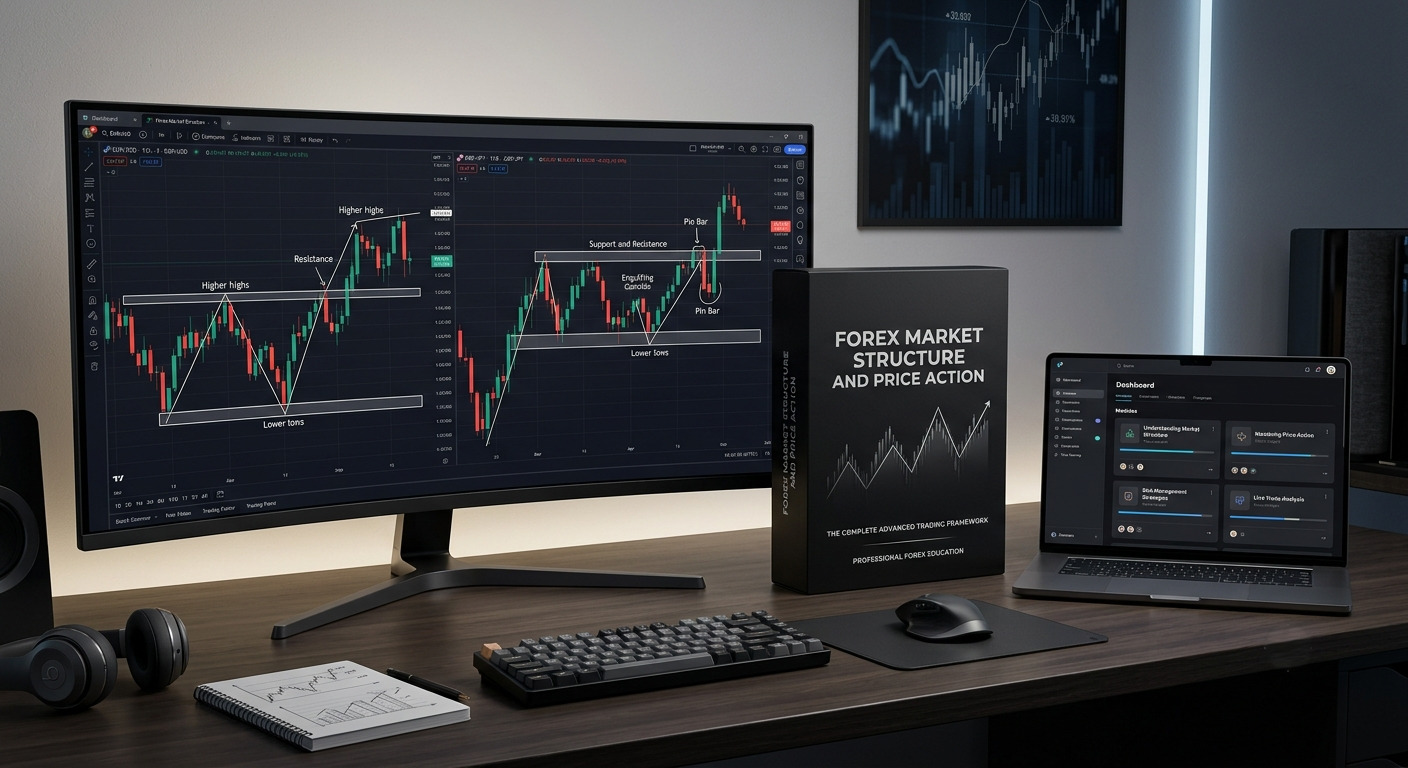
Market structure refers to the series of higher highs / higher lows (uptrends), lower highs / lower lows (downtrends), or sideways consolidations (ranges) that form on a price chart. Understanding structure helps traders determine whether the market is trending or mean-reverting, and which direction has the highest probability for the next move.
1.1 The Core Problem It Solves {#core-problem}
Most beginner traders jump straight into tactics: “buy when the RSI crosses 30” or “use this golden MA crossover”. But they have no framework for understanding why those tactics sometimes work and why they often fail. Forex Market Structure and Price Action fixes this by providing the “why” – the structural logic behind every meaningful price movement. This lifts you out of guesswork and into educated decision-making.
1.2 Who Created the Course? {#who-created}
The course is offered by Oracle FX, a forex education brand that focuses on institutional-grade concepts like order flow, liquidity, and market mechanics. While the specific author’s name may be less important than the curriculum, the methodology aligns closely with the way proprietary trading firms and experienced bank traders break down the market. The content is structured to be beginner-friendly, yet detailed enough to challenge intermediate traders.
2. How Does Forex Market Structure and Price Action Work? {#how-it-works}
At its heart, the course teaches you a repeatable process for analyzing any forex chart. This process doesn’t rely on the best forex expert advisor or any automated signal – it’s purely manual and skill-based. Here’s a simplified walkthrough.
2.1 Understanding Market Structure Step by Step {#step-by-step}
- Identify the current trend using swing highs and lows. Are we printing higher highs and higher lows? That’s an uptrend. Lower lows and lower highs? Downtrend. Equal highs and lows? Ranging market.
- Mark key structural levels – areas where price has previously reversed sharply. These become future decision zones.
- Look for liquidity pools – obvious stop-loss clusters above swing highs or below swing lows. Institutions often push price into these pools to fuel their own orders.
- Wait for price to approach a level of interest, then drop to a lower timeframe to observe the price action at that boundary.
- Confirm with candlestick rejection patterns (pin bars, engulfing candles, inside bars) that signal a potential turn or breakout.
- Plan the trade – entry, stop loss based on structure, and target at the next liquidity zone or structural level.
This is the skeleton of the course’s framework. It turns chaotic charts into a logical map.
2.2 How Price Action Complements Structure {#price-action-complement}
If market structure is the road map, price action is the traffic signal. A support level is just a line in the sand until price forms a bullish pin bar or a strong engulfing candle on lower volume – that’s the signal to act. The course teaches you to recognize these signals in real time, giving you the confidence to pull the trigger without indicator overload.
3. Key Features of Forex Market Structure and Price Action {#features}
Let’s break down the main modules and tools inside the program. Each feature is designed to shift you from hoping the best forex expert advisor will save your account, to building skills that make you self-sufficient.
3.1 In-Depth Market Structure Training {#feature-structure}
What it does: Provides video lessons, annotated charts, and exercises on identifying trends, ranges, breakouts, and reversals.
Why it matters: Until you understand structure, you’re just gambling. This module eliminates the common mistake of buying into resistance or selling into support because you “felt” it would go up.
Real trading application: You’ll be able to look at a fresh chart and instantly determine whether you should be looking for longs, shorts, or doing nothing.
Beginner benefit: Simplifies the entire chart into a handful of meaningful patterns.
Possible limitation: Purely structural traders may miss macro news events; the course could benefit from integrating basic fundamental awareness.
3.2 Price Action Analysis and Candlestick Patterns {#feature-price-action}
What it does: Teaches the most relevant candlestick formations (pin bars, marubozu, inside bars, fakey patterns) and how they interact with structural levels.
Why it matters: A level without price action confirmation is just a guess. This feature gives you an execution edge.
Real trading application: You’ll know exactly what a rejection wick means at a supply zone, and how to set an entry order just above or below the candle with a tight stop.
Beginner benefit: Moves you away from memorizing candle names to understanding the battle between buyers and sellers.
Limitation: Candlestick patterns can fail; no single signal works 100% of the time. The course teaches context, but practice is still required.
3.3 Supply and Demand Zone Identification {#feature-supply-demand}
What it does: Shows how to draw fresh supply and demand zones on the chart – areas where institutional orders are likely sitting.
Why it matters: Retail traders often draw support/resistance lines arbitrarily. Supply and demand zones are based on price inefficiency, giving you a more objective anchor.
Real trading application: When price returns to a demand zone after a strong rally, you have a high-probability area to look for longs with minimal risk.
Beginner benefit: Teaches you to trade from “value areas” rather than chasing price.
Limitation: Zone drawing can be subjective if not taught properly; the course provides clear rules.
3.4 Liquidity Concepts and Smart Money Traps {#feature-liquidity}
What it does: Introduces the concept of liquidity grabs, stop hunts, and how market makers engineer false breakouts.
Why it matters: Understanding liquidity is the closest you’ll get to thinking like an institution. Many traders looking for the best forex expert advisor don’t realize that EAs are often the easiest victims of stop hunts because they place obvious stops.
Real trading application: You’ll learn to anticipate where stops are resting and avoid placing your own stop at those obvious levels, or you can even trade the liquidity grab as a reversal entry.
Beginner benefit: Demystifies why you keep getting stopped out right before the market turns in your direction.
Limitation: Liquidity analysis works best with volume or order flow tools, which spot forex lacks. Still, price structure provides solid proxies.
3.5 Practical Trading Framework {#feature-framework}
What it does: Combines all concepts into a step-by-step trading plan, from pre-market analysis to trade management.
Why it matters: Having a framework eliminates emotional decisions and forces discipline – something an EA tries to automate, but a human can refine with experience.
Real trading application: You’ll follow a checklist: identify daily bias, mark key levels, wait for London or New York session price action, execute only if conditions align.
Beginner benefit: Gives you a clear “what to do” routine each trading day, ending paralysis.
Limitation: The framework requires patience; many beginners still want the action, which can lead to overtrading.
4. Benefits of Learning Market Structure and Price Action {#benefits}
When you commit to learning these skills, you walk away with more than just a course completion badge. Here’s what you actually gain:
- A universal skill set – Works on EUR/USD, GBP/JPY, gold, indices, and even crypto charts.
- No dependence on software or signals – You won’t need to search for the best forex expert advisor ever again.
- Deep understanding of market behavior – You’ll stop blaming brokers and start recognizing your own mistakes.
- Improved risk management – Placing stops based on structure gives you logical invalidation points.
- Reduced emotional stress – When you know why you are in a trade, you are less likely to close it early out of fear.
- A foundation for advanced strategies – Smart money concepts, ICT methods, and order block trading all build on market structure basics.
This course doesn’t promise you’ll quit your job in three months. It does promise that if you put in the work, you’ll stop losing money on setups that never made sense in the first place.
5. Why Searching for the Best Forex Expert Advisor Might Be Holding You Back {#ea-vs-education}
I need to address this directly because you likely arrived here with “best forex expert advisor” in mind. Here’s the cycle many traders follow:
- Lose money manually.
- Believe an EA will solve the problem.
- Buy or download a highly marketed EA.
- Make small profits for a few weeks (during trending markets).
- Give back all profits (and more) when market conditions change.
- Search for another “best forex expert advisor”.
The core issue is that no algorithm can adapt to shifting volatility, news events, or structural breaks the way a trained human brain can. Even sophisticated machine-learning EAs struggle without context. By contrast, the trader who understands market structure can look at the chart this morning and decide: “Today, I’m not trading because we’re stuck in a tight range ahead of the FOMC.” An EA will blindly trade through it.
Learning market structure and price action through Forex Market Structure and Price Action doesn’t just make you a better manual trader – it also helps you eventually evaluate whether an EA has any logic behind it. You’ll be able to spot systems that simply sell at resistance and buy at support, and you’ll understand why they fail when trends get strong.

6. How This Course Compares to Using the Best Forex Expert Advisor {#comparison-ea}
Let’s put the two options side by side so you can see the trade-off.
| Aspect | Best Forex Expert Advisor (Typical) | Forex Market Structure and Price Action Course |
|---|---|---|
| Learning required | Usually none – plug-and-play | Requires hours of study and demo practice |
| Adaptability | Low – fixed rules that break in ranging/volatile markets | High – you adapt your bias daily based on structure |
| Long-term profitability | Rarely sustainable without constant optimization | Depends on your skill, but a well-trained trader can compound consistently |
| Understanding of why trades work | None – a black box | Full transparency – you know the reasoning behind every setup |
| Initial cost | Often recurring subscription or high upfront fee, plus VPS | One-time course fee (visit product page for current pricing) |
| Emotional involvement | Minimal, but anxiety rises when EA hits losing streak | You experience emotions, but the course helps build discipline |
| Skill gained | Zero – you remain dependent | A lifelong trading skill that no one can take away |
If you’re dead set on automating a specific, proven strategy, an EA built after you deeply understand the strategy may have a place. But starting with the best forex expert advisor search before you understand the market is like trying to build a self-driving car without knowing how to drive.
7. Who Should Use Forex Market Structure and Price Action? {#who-should}
7.1 Ideal Students {#ideal}
- Beginner forex traders who want to build a solid foundation from day one.
- Intermediate traders struggling with consistency and looking for a structured framework.
- Technical analysis enthusiasts who feel indicator-heavy charts are confusing.
- Traders transitioning from forex signals or EAs who want to learn true independence.
- Anyone who has searched “forex market structure course” or “learn price action trading” hoping to make sense of the charts.
7.2 Who Might Want to Skip It {#skip}
- Traders looking for a get-rich-quick scheme or guaranteed weekly profits (this course won’t promise that).
- People unwilling to spend 4–6 weeks of demo practice before going live.
- Those who cannot handle any form of discretionary decision-making and want a fully automated system.
- Experienced, profitable traders who already trade using institutional market structure concepts – you likely already know this material.
8. Real-World Trading Use Cases {#use-cases}
To make this tangible, here’s how a graduate of the course might approach a typical trading week.
Monday Morning Analysis:
Pull up the EUR/USD daily chart. You notice the pair has been making higher highs and higher lows since mid-month – a clear uptrend. You mark the most recent swing low as the structural support that must hold for the trend to continue. You then drop to the 4-hour chart and identify a demand zone near that level where price previously exploded upward.
Tuesday – Price Approaches the Zone:
Price drifts lower during the Asian session and tags the demand zone. You observe the 15-minute chart and spot a strong bullish engulfing candle, closing above a minor resistance. You enter long with a stop loss 5 pips below the zone, targeting the recent swing high. Your risk is defined, your reasoning is logged, and you walk away.
Outcome and Learning:
Whether the trade hits target or stops out, you review the tape. Did you correctly identify the trend? Did you misinterpret the zone? Over 20 such trades, the course’s framework will help you see your win rate and risk-to-reward ratio clearly.
This is miles away from blindly following a signal from the best forex expert advisor you downloaded last night. It’s a professional process.
9. Forex Market Structure and Price Action Pricing, Offers & Value {#pricing}
Oracle FX currently offers the Forex Market Structure and Price Action course as a one-time purchase. While exact figures can vary due to promotions, the typical pricing places it in the affordable-to-mid-range bracket for a specialized forex trading course.
When you consider the cost of a typical forex trading course – or the lifetime cost of subscribing to a “best forex expert advisor” signal service that charges $30–$100/month – this educational investment can pay for itself within a couple of avoided stop-outs. There are no recurring fees, and you get lifetime access to the material (including any updates).
Look out for any available forex course discount on the product page. The value proposition is strong if you treat it as an investment in your trading career rather than a quick fix.
10. Pros and Cons {#pros-cons}
Pros:
- Comprehensive coverage of market structure and price action from basics to advanced concepts.
- Structured, step-by-step curriculum that prevents information overload.
- Teaches a skill that applies across all currency pairs and timeframes.
- Removes reliance on third-party signals or the best forex expert advisor.
- Logical, framework-based approach reduces emotional trading.
- Accessible to total beginners without dumbing down the content.
- Potential to save hundreds of dollars in future trading losses.
Cons:
- Requires real dedication and screen time; not passive income.
- Limited focus on fundamental analysis or news trading.
- Some topics (like liquidity concepts) can feel abstract in spot forex without volume data.
- Not suitable for traders who want to be told exactly what to trade every day.
- Pricing details are not openly displayed – you need to visit the product page.
11. Trust & Transparency Section: Realistic Expectations
I won’t insult your intelligence by pretending this course will turn you into a millionaire by the end of the month. Here’s what you can realistically expect:
- Who benefits most: Disciplined individuals willing to practice on a demo account for at least one to three months, keeping a trading journal and reviewing every trade.
- Who should avoid: Anyone looking for a “holy grail” system, quick income, or a replacement for gainful employment.
- Realistic outcomes: You will likely not be profitable immediately. But by the end of the course, you should be able to identify high-probability structural levels, avoid obvious stop-hunt areas, and execute a trade with a clear plan. For many, that’s the first time they trade with genuine confidence instead of hope.
- The importance of risk management: The course teaches structure-based stop placement, but you must still commit to risking only a small percentage of your account per trade. No educational content can replace personal discipline.
Forex trading involves substantial risk of loss and is not suitable for all investors. Past performance in demo or hypothetical results does not guarantee future outcomes. Always trade with money you can afford to lose.
12. Comparison: Market Structure Education vs. Other Learning Methods
You have multiple paths to learn forex trading. Here’s how Forex Market Structure and Price Action stacks up against the alternatives.
| Learning Method | Pros | Cons | Best For |
|---|---|---|---|
| Free YouTube Videos | Zero cost, huge variety | Fragmented, no structured progression, mixed quality | Casual learners testing the waters |
| Self-learning from Books | Deep theory, own pace | No practical chart walkthroughs, easy to get stuck | Theorists who enjoy reading |
| Generic Forex Trading Course | Often covers basics well | May not dive deep into smart money / market structure | Beginners wanting a broad overview |
| Mentorship / 1-on-1 Coaching | Personalized feedback | Extremely expensive ($1,000s) | Those who can afford it |
| Buying the Best Forex Expert Advisor | Passive, no learning needed | No skill growth, unsustainable, often scams | Traders who refuse to learn manual trading |
| Forex Market Structure and Price Action (Oracle FX) | Structured, affordable one-time cost, institutional perspective | Requires effort; no live trading room included | Serious beginners/intermediates wanting lasting skill |
If you want to ultimately be able to make your own trading decisions and stop depending on the next flashy “best forex expert advisor”, this course fills a gap that free content rarely addresses: a complete thought process from context to execution.
13. Best Practices to Get Better Results from the Course
Simply watching the videos won’t make you a profitable trader. Follow these steps to maximize the value of your investment.
- Start with a demo account. Treat it like real money. Only go live once you have 2–3 consecutive profitable months on demo.
- Keep a detailed trading journal. Screenshot every trade setup, note the structure, the price action trigger, and the outcome. This builds pattern recognition faster than anything else.
- Master one or two currency pairs first. EUR/USD and GBP/USD offer clean structure and low spreads.
- Revisit the course modules. As you gain experience, re-watching the liquidity or supply/demand sections will reveal nuances you missed initially.
- Don’t ditch the framework when you lose. Losing streaks happen; the framework is your anchor.
- Resist the urge to add extra indicators. The whole point is to read pure price. Oscillators will only distract and contradict.
- Backtest manually by scrolling through historical charts. Test how well you can spot structural levels and see what price did.
- Limit your trading sessions. If you follow the London and New York opens, give yourself a 2–3 hour window; outside that, don’t force trades.
14. Frequently Asked Questions (FAQ)
1. What is Forex Market Structure and Price Action?
It’s an online trading course by Oracle FX that teaches you how to analyze forex charts using market structure, price action, supply and demand, and liquidity concepts, helping you make independent trading decisions.
2. Is Forex Market Structure and Price Action worth it?
For traders willing to put in the practice, absolutely. The course gives you a complete framework that reduces guesswork and helps you understand why the market moves – something no “best forex expert advisor” can teach.
3. Can beginners learn price action trading with this course?
Yes. The course starts with fundamental definitions and gradually introduces more advanced ideas. Beginners who follow the modules in order and practice on a demo chart will build competence steadily.
4. Is this forex course suitable for new traders?
Yes, it’s designed with beginners in mind. However, total newcomers may need to spend extra time on basic candlestick and terminology lessons before absorbing the structure concepts fully.
5. Does this course teach a specific forex strategy?
Rather than a single “entry rule”, it teaches a flexible trading framework based on structure and price action. This framework allows you to develop your own high-probability strategy suited to your lifestyle and timeframe.
6. What makes this different from other forex courses?
Its focus on market structure and institutional concepts (liquidity, smart money) sets it apart from generic indicator-based courses. It also equips you with a skill that you can use for life, unlike signal services or the search for the best forex expert advisor.
7. Is Forex Market Structure and Price Action available internationally?
Yes, as an online course, you can access it from the USA, UK, Canada, Australia, Europe, and anywhere with an internet connection. All content is in English.
8. Can this course help traders understand market structure better?
That is exactly its main purpose. You will learn to identify trends, ranges, breaks, and reversals with clarity, which is the foundation of any successful trading system.
9. Is this better than learning forex for free on YouTube?
Free content is useful, but it’s rarely structured and often contradictory. This course provides a linear learning path, saving you months of confusion and misinformation.
10. Does this guarantee forex profits?
No educational course can guarantee profits. Trading involves risk, and your results depend on discipline, risk management, and market conditions. The course equips you with a skill – the outcome is in your hands.
15. Final Verdict: Is Forex Market Structure and Price Action Worth It?
If you’ve spent weeks or months chasing the best forex expert advisor, it’s time to consider a different approach. Automation cannot give you the contextual understanding that makes a trader consistently profitable over years and across market regimes. Forex Market Structure and Price Action by Oracle FX delivers that understanding in a clear, structured format.
The course won’t do the work for you, and it certainly won’t eliminate the emotional challenges of trading real money. But it will give you a professional-grade lens through which to view every chart you open. You’ll finally understand why price stopped where it did, where the real buying and selling pressure exists, and how to align yourself with the big money rather than getting trapped by it.
I recommend this course for:
- Beginners who are serious about trading as a long-term skill.
- Intermediate traders tired of hopping from indicator to indicator.
- Anyone who has ever wondered, “Why does the market always hit my stop loss and then fly in my direction?”
I hesitate to recommend it for:
- Those seeking a passive, hands-off income solution.
- Traders unwilling to log at least 50–100 practice trades before committing real capital.
If you’re ready to stop searching for the best forex expert advisor and start building authentic trading expertise, visit the official Forex Market Structure and Price Action course page below and see if the curriculum resonates with your goals. Remember, the only tool that never expires is the one between your ears.



0 Comments